
Sociocultural approaches in the lithographic book of SadPand (One Hundred Counsels)
Zahra Ziaie
Zahra Ziaie is PhD Candidate in Fine Arts at the Complutense University of Madrid. (zaziaie@ucm.es)
Abstract
SadPand (One Hundred Counsels) is one of the illustrated lithographic books from the time of Mozaffar al-Din Shah Qajar, produced by his order for use in teaching the second grade of primary school. Compiled and translated in 1905 by Mirza Ali Asghar Jan Pishjedmat, the book contains one hundred moral narratives accompanied by nineteen illustrations, without mentioning the name of the artist or the author, an aspect that has received little scholarly attention to date. This research aims to examine the contexts and hidden symbolic layers of several selected illustrations, based on the content of the counsels and the visual elements used, which more accurately reflect the sociocultural perspectives of the period. As a result of this research, it can be stated that the illustrations in this book constitute a valuable work that can be considered a historical document of a nation’s identity in the Qajar era and offer a valuable basis for studying the art and the cultural and social contexts of that period. Furthermore, it is worth noting that, during this historical period, due to the close and continuous contacts between Iran and Europe, a strong influence of European art is evident in the art of Iran, especially in illustration. This article examines the aforementioned book from the perspective of Islamic art aesthetics, given its direct connection to Iranian painting and the aesthetic principles involved. The research method is descriptive-analytical, and the method of source collection is bibliographic.
Keywords: Qajar Period, Lithography, SadPand, Persian Illustration, Sociocultural Approaches
Introduction
Qajar refers to the dynasty that ruled Persia from 1794 to 1925. During the Qajar period, the spread and growing popularity of lithography enabled the book to move beyond its courtly, single-copy format and become accessible to a wider audience. Since manuscripts prepared in the royal library under the supervision of the kings were considered part of their principal capital, great attention was devoted to their preservation and care. Therefore, as the book transitioned from the court to the public sphere, its price decreased significantly and it began to be offered as an inexpensive commodity. Edward Burgess (1831–1905), an Englishman residing in Tabriz, wrote in a letter to his brother on this matter: “Sixteen printing houses are operating only in Tabriz alone, and therefore the price of books has become so low that the work of copyists and scribes has suffered greatly, and a Shāhnāmeh[1] can be purchased for six pence.” (Aghdashloo, 2006, p. 168) The illustrator of the Sadpand book has depicted the religious, historical, cultural, and social realities of the Qajar era in the form of moral narratives. His work offers insight into the prevailing worldview of that period. In this article, after a brief reference to the research questions, background, and adopted methodology, the roots of the terms aesthetics and sociology are first explored; next, the formation of this discipline is examined from a historical perspective; subsequently, the visual structure of several examples from the book’s illustrations is analyzed and discussed; finally, the influence of European art on the works produced is addressed; and in the concluding section, the questions and ambiguities that have arisen outlined below, are answered.
[1]. The Book of Kings is one of the masterpieces of world literature. Written by Hakim Abu’l-Qasem Ferdowsi between the late tenth and early eleventh centuries, it constitutes the national epic of Iran, that is, of Persia.
Research Questions
- Are the illustrations in the Sadpand book a valuable source of information about the cultural elements of the Qajar period?
- Is it possible to identify the beliefs and social perspectives of the time through an understanding of the lithographic images in the Sadpand book?
- To what extent did European art influence Qajar art, particularly during the third period (the reign of Mozaffar al-Din Shah Qajar)?
Research Background
To date, studies have been conducted on other illustrated lithographic books, and according to the research carried out in this field, none of them address the specific topic examined here, except for one case in which the mentioned book was only briefly introduced. It is expected that, from now on, more extensive reference will be made to these works. Among the studies conducted on lithographic books in Qajar Iran, the following may be noted:
Mohammad Hadi Mohammadi and Zohreh Ghaeni, in the third volume of the ten‑volume series The History of Children’s Literature in Iran, dedicated specifically to children’s literature during the Mashruteh Era, mention only the name and identity of the Sadpand book.
Olympiada Pavlovna Shcheglova, in her book History of Lithography in Iran, first examines the beginnings of lithography in Iran and the establishment of the earliest lithographic printing houses, and then distinguishes between public and private printing houses. Ulrich Marzolph, in his book Narrative Illustration in Persian Lithographed Books, studies a particular type of Iranian lithography. The illustrations include various scientific books, textbooks, travelogues, historical works, translations of European literature, and portraits of men of letters published in the press of the Qajar period. He also introduces the artists who worked on lithographic book illustration and their works, and enumerates the unique characteristics of
Research Method
In this study, in order to identify the principles and rules that the illustrator of the Sadpand book adopted from Islamic art, a descriptive–analytical research method was employed to gather information and to describe and analyze elements that might reflect cultural values, as well as the social and religious beliefs of the period in which the work was created, in addition to its artistic qualities. Therefore, to understand the trajectory and working approach of the artist who illustrated this book, a bibliographic method of source collection was used, drawing on first‑tier sources and books on Qajar history and the history of lithography, as well as articles and studies by national and international researchers, and travel accounts from the period
A Look at the Term “Aesthetics” from an Etymological Perspective
Since every work of art is a collection of signs that transcend the individuality of the artist and relate to the culture and beliefs of a society at a given time, it is impossible to recognize and examine a work of art without understanding the social, economic, political, and cultural conditions of its era. Therefore, it can be stated that analyzing the sociological value of aesthetics facilitates the understanding of the hidden meanings within images. Through this research process, in addition to understanding the subject and content of the work, one can also achieve a proper understanding of the conditions under which it was formed. Since during the reign of Mozaffar al-Din Shah Qajar the art of illustration adopted a new form of expressing the social realities of its time, the method of sociological aesthetics allows for an adequate understanding and analysis of the works produced in this period. “The root of the word aesthetics derives from the Greek aesthesis and the verb aisthanesthai, meaning ‘to perceive’ and ‘to feel.’ Thus, in this regard, one group of philosophers and thinkers has emphasized rational judgment, while another group considers the expression of emotion as the true domain of beauty, and yet another group believes in the participation of both poles, considering neither permissible nor complete on its own.” (Soltan Kashefi, 1998, p. 15) Aesthetics is an approach dedicated to conceptual and theoretical inquiry in the field of art and aesthetic experience (Levinson, 2008, p. 9). In general, it can be understood that aesthetics has taken diverse and complex forms over time, something evident in numerous works of art. Aesthetics may be understood as a capacity to better comprehend aesthetic objects, activating a distinct attitude that, unlike the natural sciences, involves an emotional dimension. The aesthetic value of a work becomes perceptible when it can present itself to the viewer as an entity independent of the mind and stimulate mental activity. It can be said that every artistic phenomenon is explained by causes external to art, which are at once less legitimate and possess less spiritual value. The external causalities identified by the sociology of art may arise from various social, material, economic, cultural, and worldview systems within a society, which, crystallizing in each artist, represent the state of customs and traditions, the spirit of the nation, the era, and the moral environment in the work created by each artist (Hinnick, 2012, p. 32).
Examining Social Perspectives from a Historical Viewpoint
In general, historians have divided the Qajar monarchy into three periods. The first, which lasted nearly forty years (1794–1834), coincided with major events in world history, such as the French Revolution and the rise of Napoleon I, as well as the particular attention that certain European rulers paid to Iran. The second period of the monarchy, spanning from 1834 to 1895, strengthened the idea of change and the need for the rule of law, as well as the end of authoritarian governance, through the establishment of Dar ol‑Fonun[1] and the gradual familiarization of Iranians with global developments and transformations.
The third period of the monarchy (1895–1925) laid the foundations for a political and intellectual movement among Iran’s intellectual classes and advocates of freedom. During a four‑year revolution, the authoritarian Qajar monarchy was transformed into a constitutional parliamentary monarchy. The result of the political pressures exerted by the two expansionist governments of Russia and England, along with the armed interventions of the Allied Powers and the Axis Powers in Iran during the First World War, seriously threatened Iran’s independence and disrupted the country’s social and economic fabric (Shamim, 1991, pp. 45, 123, 279).
“The successive defeats of Iran at the hands of Russia between 1803 and 1827 led a group of Iranians especially Abbas Mirza, son of Fath Ali Shah Qajar, who participated in the wars, to recognize for the first time the weakness and backwardness of Iranian science and technology. Abbas Mirza devised a solution and, aware of developments in Russia and the Ottoman Empire, ordered that all authentic foreign books be translated into Persian and printed so that the people could read them and share scientific knowledge.” (Floor & Chelkowski, 2003, p. 89)
During the second period of the monarchy, most writers, especially translators, presented their work as a service to the people and emphasized the need to disseminate knowledge and acquire cultural and artistic understanding. As a result, textbooks in various fields of the exact and experimental sciences experienced significant growth, particularly after the establishment of Dar ol‑Fonun. All of these works were translations, to which translators sometimes added introductions or made small modifications according to their own views (Momeni, 1975, pp. 15–16).
Given that the lithographic book Sadpand was translated and printed during the reign of Mozaffar al‑Din Shah (1895–1906), and under his command, it is pertinent to examine the cultural and artistic productions developed during that period.
During the era of Mozaffar al‑Din Shah, the publication of foreign newspapers and books began to take root in popular consciousness. Sending students abroad to learn technical and artistic skills, as well as to become familiar with foreign languages, proved effective in disseminating new ideas and introducing humanistic and naturalistic perspectives. For this reason, several modernist thinkers considered the possibility of writing books. Outside Iran, in countries such as India, Egypt, and the Ottoman Empire, books were published within this context for Persian‑speaking children, and they reached Iran through various channels. The source of several books from this period, rewritten as adapted fragments for children, is classical Persian literature. Others consist of collections of moral tales and stories drawn from various foreign sources, compiled, adapted, or translated by writers familiar with European languages. The language of most of these works is relatively simple and suitable for a child and adolescent readership.
The common feature of all the books from this period is their moral perspective. A collection of fables drawn from foreign sources can be observed, such as those of Aesop and La Fontaine, which are also mentioned by the author of the lithographed book Sadpand: “In 1905, Mirza Ali Asghar Khan Pishkhedmat compiled and translated one hundred moral fables and published them in small full‑page books called Sadpand. The text of the book does not mention its original source, Aesop’s fables. In the rewriting, the language of the fables and some descriptions have been modified. At the center of the fables, there are quotations from Ferdowsi and other major Persian literary figures” (Mohammadi & Ghaeni, 2001, p. 292). During this period, portraits of the Shah were also painted on pocket watches and water pipes (Vernoit, 2004, p. 104). (figs. 1–2).
[1]. Dar ol‑Fonun was the name of a secondary school established in Tehran at the initiative of Amir Kabir during the reign of Naser al‑Din Shah Qajar, intended to teach new sciences and technologies. Dar ol‑Fonun may be considered the first modern university in the history of Iran. (Adamiyat, 1975, p. 43)
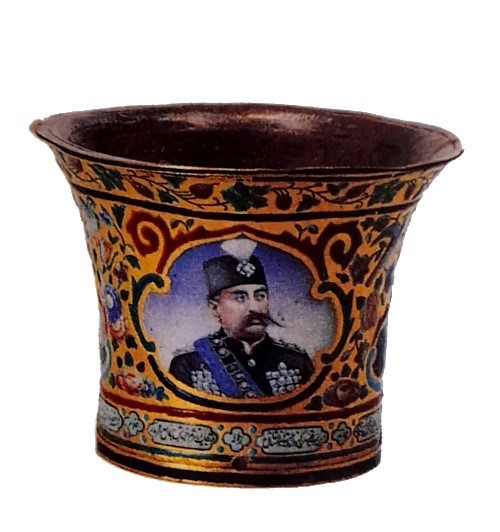
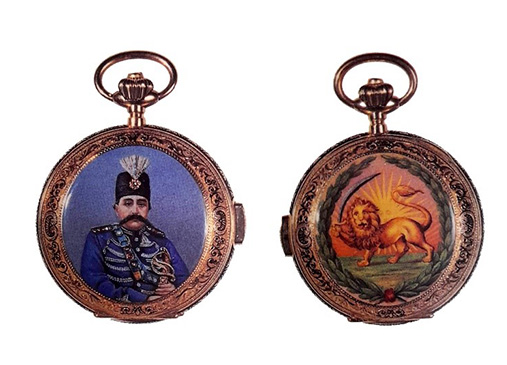
Fig. 1. Painted portrait of Mozaffar al Din Shah on a water pipe. (Vernoit, 2004, p. 122).
Fig. 2. Painted portrait of Mozaffar al‑Din Shah on a pocket watch, with a lion and sun motif behind the watch. (Vernoit, 2004, p. 123).
Painting in Iran became progressively Westernized under the influence of Mohammad Ghaffari (Kamal‑ol‑Molk)[1], who returned to Iran after a five‑year stay in Europe devoted to the study of art. He was entrusted with faithfully recording events, people, and court environments, introducing into his works elements of Western art such as perspective, the creation of three‑dimensional spaces, shading, and the use of European‑style oil painting (figs. 3–4). (Pakbaz, 2008, p. 362). Therefore, many elements of Western art can be observed in the paintings of this period. Photography also developed during this time, and experiments were carried out in the field of cinema. One of the most prominent figures in this domain was Mirza Ebrahim Akkasbashi, who accompanied Mozaffar al‑Din Shah on his trip to Europe and produced the first Iranian films (Khansalar, 2005, p. 180).
[1]. The Iranian court painter of Naser al‑Din Shah Qajar (1848–1940) is considered the most famous and influential figure in the history of modern Iranian art. After the death of Naser al‑Din Shah, he travelled to Europe to pursue his studies and spent more than three years in Florence, Rome, and Paris, where he copied works by masters such as Rembrandt and Titian in various museums. His journey to Europe had a positive impact on both his working style and his artistic outlook, and it can be said that his oeuvre represents the culmination of a two‑hundred‑year process of combining Iranian and European traditions, consolidating the European naturalist tradition. He returned to Iran in 1900, by order of Mozaffar al‑Din Shah.
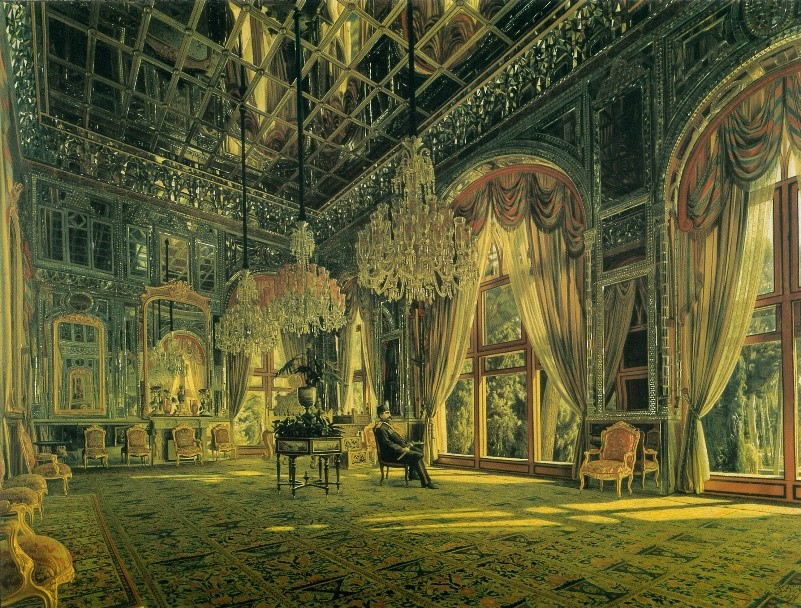
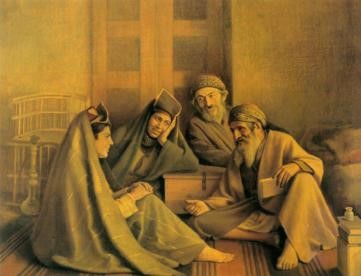
Fig. 3. Kamal‑ol‑Molk, Hall of Mirrors (1896). Oil on canvas, 91 × 119 cm. Golestan Palace, Tehran.
Fig. 4. Kamal‑ol‑Molk, The Fortune‑Teller of Baghdad (1899). Oil on canvas, 46 × 55.5 cm. Library of the Iranian Parliament, Tehran.
Reflection of Social and Cultural Influences in the Lithographic Book Sadpand (One Hundred Counsels)
When examining the illustrations of the book Sadpand, we notice that the illustrator depicted these images with complete fidelity to the narratives; all of them portray scenes from the lives of ordinary people and reflect the customs and traditions of the time. Olimpiada Paviona Scheglova highlights that “the most valuable and distinctive feature of Iranian lithographs is that they reflect Iranian culture in the nineteenth century and during the Qajar period. They include historical sources, works by poets, religious writings, and modern textbooks—that is, textbooks that no longer followed the style or form of medieval literature” (Scheglova, 2011, p. 26). Most translations of books from this period are neither exact nor complete, and although translators used the terms translation and authorship for their works, many of them can be considered interpretations or free adaptations. Several translators also failed to mention the name of the original author.
Shahla Babazadeh explains the reason for these changes as follows: “Each language has a special sweetness of its own, and when translated into another language, it does not convey that flavor, especially because French is completely different from Persian” (Babazadeh, 1999, p. 55). The book examined in this article was no exception, and its translator, Mirza Ali Asghar Kaan Pishkhedmat, chose Iranian names for the characters. Another notable feature of this book is the transition from the formal language of ancient tales to a simple, newspaper‑like language.
The following section analyzes several illustrations from the lithographic book Sadpand from a sociocultural perspective, allowing us to understand the images not merely as visual accompaniment to the text but as cultural documents within the Persian literary and visual tradition.
Aesthetic Analysis of Selected Pages
The analysis focuses on several levels
- Perspective and spatial construction for identifying how the gaze is organized and what visual hierarchies are established.
- Composition, considering the arrangement of figures, the relationship between characters, and the implicit narrative structure.
- Motifs and ornaments, which allow us to trace iconographic repertoires characteristic of the period and their symbolic function.
- Depth of field and treatment of the plane, as indicators of visual techniques and aesthetic conventions.
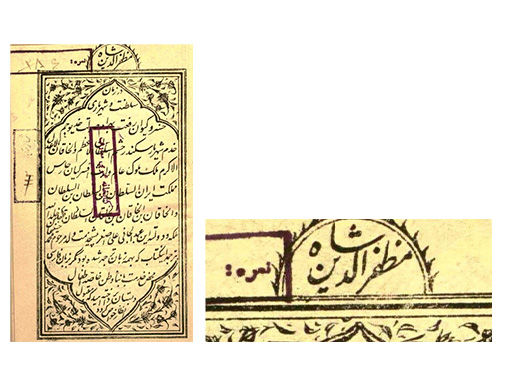
The inner cover page (fig. 5) consists of two main parts: text and decoration. The text is varied and can be divided into three sections:
- Introduction, which includes detailed praises of Mozaffar al‑Din Shah.
- Main text, where the translator explains the purpose of his work, noting that Sadpand had been translated into various languages except Persian.
- Conclusion, containing instructions, wishes, and even a prayer. According to Ali Asghar Khan Pishkhedmat, the reason for the translation was “to serve the prophets of the homeland, especially primary‑school children, and he wishes to be accepted by the elite” (Unknown, 1905, initial page).
In the image, the name of Mozaffar al‑Din Shah appears prominently in a semicircle at the top, underscoring the relevance of monarchs in the publication and translation of books.
The first page of the book Sadpand (fig. 6) features rich decoration with angels and vegetal motifs that fuse Iranian and European styles. At the center, the word “Hova”, referring to God, and the book’s title are highlighted. Traditionally, old books lacked page numbers and used the term “Rekabeh” to indicate sequence. This meant that the first word of the first line of the following page was written in the lower left[1] corner of the current page (Hashemi Dehkordi, 1984, p. 100). (fig. 7) However, this book combines that practice with the inclusion of page numbers at the top.
[1]. In lithographic books, it was generally placed at the center or on the left side of the page (Naghibi, 2008, p. 333).
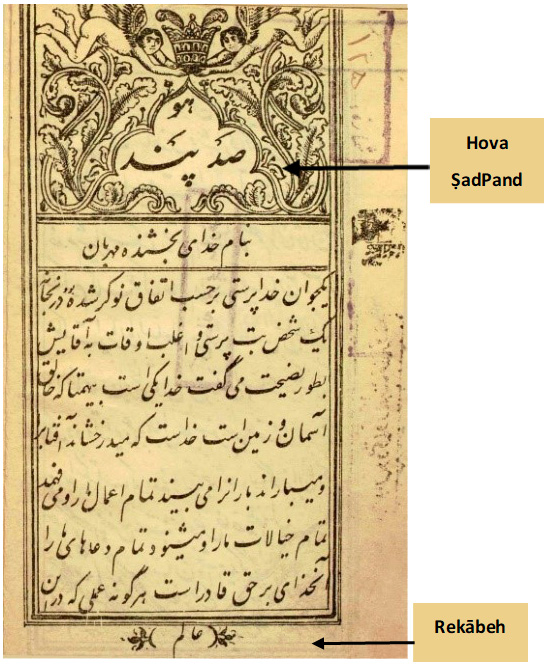
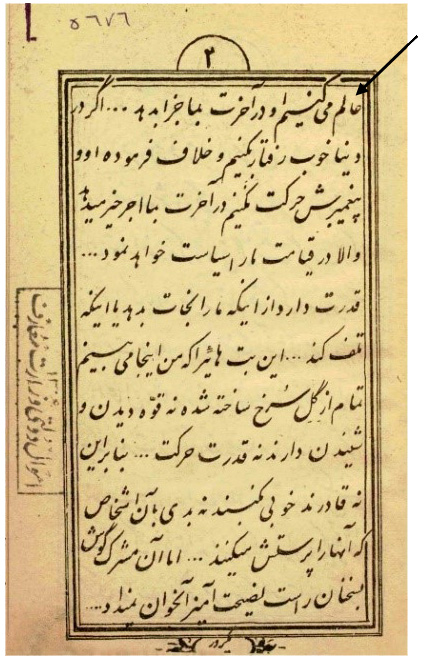
Fig. 6-7. Unknown artist, First page of the book Sadpand (1905). Lithograph. National Library and Archives of Iran.
One of the illustrations in this book, linked to counsel fifty‑nine, titled “Bread,” depicts a charitable man distributing bread to hungry children during a famine (Fig. 8). The benefactor wears a tunic, trousers, and a hat. He holds a basket in one hand and offers bread to the hungry with the other. The children stand facing one another, their clothing shaded with cross‑hatching. In the background, brick buildings in the Qajar architectural style separate the upper half of the image from the lower half, their flat façades decorated with tall windows. The use of diagonal lines to depict the paving stones in front of the buildings, along with soft shadows of appropriate contrast and linear hatching on the rooftops, gives the image beauty and depth. The artist has represented one of the greatest tragedies of Iranian history of the period, a famine that killed approximately one‑third of the population and aims to teach children an act of profound spiritual value. These images are valuable for their authenticity in reflecting Qajar art, a realist style inspired by the principles of Renaissance painting.
The illustration “Mirror,” connected to counsel sixty‑nine, shows a scene in which two siblings, Habib and Habibe, look at themselves in a mirror (Fig. 9). On the right, their mother advises them. While Habib boasts of his beauty, Habibe, marked by smallpox scars, feels sad. The image highlights careful visual detail, using Qajar decorative elements to avoid empty space. One of the fundamental principles of Islamic art aesthetics is the overcoming of ornamental voids. Wherever an area of the image might remain empty, it is filled with an element such as a window and curtain, two framed pictures, and two wall sconces entering the composition from the right and left corners. On the floor, there are two flowerpots and a relatively large vessel, and the ground features a carpet pattern, a recurring element in other illustrations of the text. On the other hand, the lack of attention to a specific light source, an influence from earlier periods of Iranian painting, is also frequently found in lithographic images. This characteristic is evident here as well: the elements of the image are shaded through hatching, and the shadow never takes the form of a solid black mass.
With the spread of lithography, art ceased to be a monopoly of the court and became integrated into the daily life of ordinary people. It freely represented domestic scenes, moving away from aristocratic exclusivity.
The final section of the book Sadpand narrates the life of an elderly man named “Brief Smile” in counsel ninety‑nine (Fig. 10).
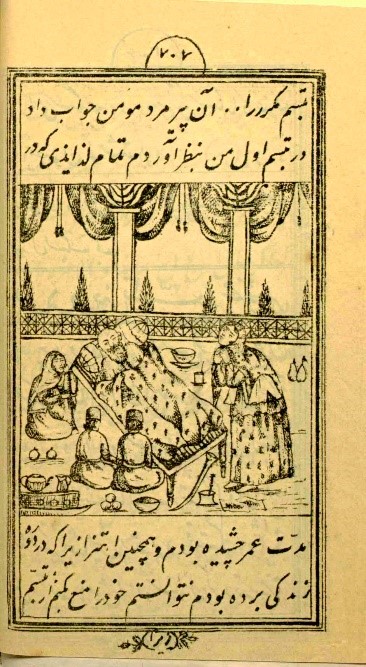
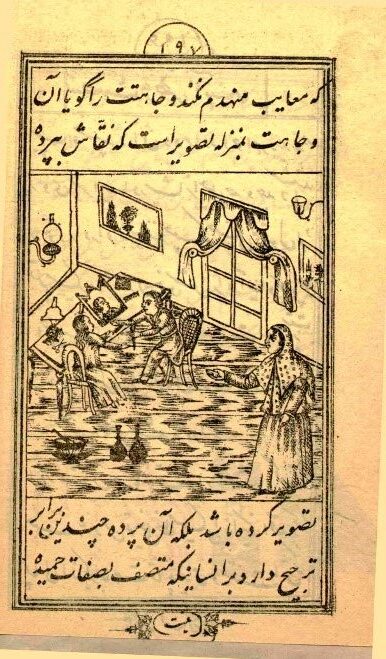
Fig 9
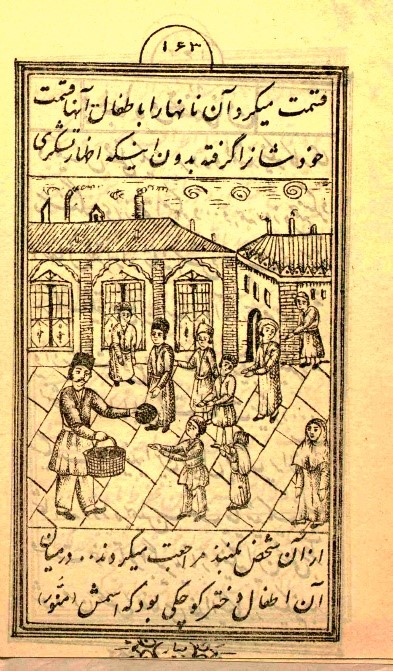
Fig. 8.Unknown artist, Bread, Leaf from the book Sadpand (1905). Lithograph. National Library and Archives of Iran.
Fig. 9. Unknown artist, Mirror, Leaf from the book Sadpand (1905). Lithograph. National Library and Archives of Iran.
Fig. 10. Unknown artist, Brief Smile, Leaf from the book Sadpand (1905). Lithograph. National Library and Archives of Iran.
The illustration presents a composition in two planes: the foreground with the elderly man and his entourage, and the background with curtains, railings, columns, and trees. The construction of space and the attention given to the background are noteworthy features of this book, rooted in a type of spatialization common in the paintings of the period, including the works of Kamal‑ol‑Molk. In the illustration, the elderly man’s bed is drawn at an oblique angle, and the most striking aspect is the spiral composition of the scene, especially visible in the figures surrounding him. The elderly man and his bed are more prominent than the other characters due to their importance in the painting, magnified through positional perspective. This reinforces the coherence and unity of the scene, emphasizing its significance. The last page of the book mentions elements such as completion, the date of completion, a request for prayers from the reader, and the preservation of copyright[1].
[1]. Copyright is a right that prevents the reprinting of a book without the permission of the publisher or author. In lithographic books, the right to reprint a book by the publisher (printer) was initially made public through various methods, such as religious or customary restrictions, announced within these copies. Later, the inalienable right of the publisher or author was printed through an official notice with legal monopoly granted by the government, specifying the limitation period and including the signature and seal of the minister in office at the beginning or end of the lithographic copies (Soltanifar, 2006, p. 91).1
Conclusion
Based on the studies carried out on the images of the lithographic book Sadpand, both written and illustrated documents from the Qajar period can be obtained. Elements such as clothing and hairstyles of women and men, men’s beards and mustaches, carpets, sources of illumination, interior furnishings, sleeping habits and equipment, professions and occupations, education, death and religious gatherings, architecture, food and drink, household utensils and furniture, charitable acts, and daily needs constitute highly valuable visual records of the cultural and social life of the Qajar people during the era of Mozaffar al‑Din Shah.
These images also offer insight into the social perspectives of the time and can undoubtedly be considered among the most valuable illustrated books for children, since the work was developed in response to the intellectual and educational needs of the society of the period, with the aim of strengthening childhood education by promoting pedagogical models appropriate for young readers. Therefore, its illustrations largely lose their decorative value and become practical symbols, as their intended audience is primary‑school children rather than adults or the general public. In this lithographic edition, we witness a moral model suitable for the education, manners, and behavior of children in various aspects of life, with each counsel highlighting subtle points.
It should also be noted that during the Qajar era, close and continuous contacts were established between Iran and Europe, something unprecedented in Iranian history. These exchanges had a strong impact on the arts and crafts of the country, leading to changes in visual elements within illustration, such as the use and type of line, surface, depth, and composition. As a result, the placement of motifs and decorations within the pages, tabulation, and similar features gradually lost their former importance.
Bibliographic References
Adamiyat, F. (1975). Amir Kabir va Irán. (4.ª ed.) Teherán: Jārazmi.
Aghdashloo, A. (2006). Zaminy va āsemāny: Negāhy be jošnevisy-e iraní az goẕaštē tā emruz. Teherán: Entešārāt-e Farzān-e Ruz.
Babazadeh, Sh. (1999). The History of printing in Iran. Teherán: Biblioteca Ṭahuri.
Desconocido. (1905). ṢadPand. (A. Pišjedmat, Trad.). Ubicación de Almacenamiento: Teherán: Biblioteca Nacional y Archivos de Irán.
Floor, Willem M., Chelkowski, P. y Ekhtiar, M. (2003). Art and artist in Persia. (Y. Azhand, Trad.). Teherán: IL-e Šāhsevan-e Bağdādi.
Hashemi Dehkordi, H. (1984). Čāpesangi, ḥayāt-e tāzeh-ie dar ketābat. Revista trimestral Honar nº7 (pp. 90-107).
Heinich, N. )2012(. Sociologie del’ Art. (A. Nikgohar, Trad.; 3.ª ed.). Teherán: Āgah.
Khansalar, Z. (2005). Paĵuheši dar taṣvirsāzi-e ʿāmiāneh va ketābārāi-e doreh-e Qāŷār. Revista trimestral de Farhang-e Mardom, nº14-15 (pp. 178-187).
Levinson, J., Guyer, P. (2008). Zibāiy Šenāsi-e falsafi. (F. Majidi, Trad.). Teherán: Farhangestān-e honar.
Marzolph, U. )2001(. Narrative Illustration in Persian Lithographed Books. Netherlands: Brill Press.
Vernoit, S. )2004(. Gerāyeš be Ğarb: dar Honar-e Qāŷār, Otomano e India (P. Behtash, Trad.; Vol. 6). Teherán: Kārang.
Mohammadi, M., Ghaeni, Z. (2001). The History of Children’s Literature in Iran. (Vol.3). Teherán: Čistā.
Momeni, B. (1975). Adabiyāt-e Mašruṭeh. (2.ª ed.) Teherán: Golšāiy.
Naghibi, A. (2008). Viĵegi-hā va pišineh-e Čāpesangi va Sorbi. Revista bitrimestral Āyeneh-e mirāş nº42 (pp. 327-338).
Pakbaz, R. (2008). Dāyeratol Maāref-e Honar (Enciclopedia del arte). (7.ª ed.) Teherán: Farhang-e Moʿāṣer.
Scheglava, O. (2011). Taḥqiq dar hozeh-e ketābhāye Čāpesangi be zabāne fārsi. (Y. Ivansian, Trad.). Ketāb-e māh-e kolliāt nº159 (pp. 23-26) Teherán.
Shamim, A. (1991). Irán dar doreh-e salṭanat-e Qāŷār. (2.ª ed.) Teherán: Šerkat-e Čāp va Entešārāt-e Elmi.
Soltan Kashefi, J. (1998). Zibāiy dar esārat-e kāj-e hezārtuy-e tafakkor. Honarnāmeh nº0 (pp. 14-23) Teherán: Dānešgāh-e Honar.
Soltanifar, S. (2006). Ḥaqe ṭabʿ dar kotob-e Čāpesangi. Revista trimestral de Ketāb nº65 (pp. 91-98).
[1] . Los derechos de autor son un derecho que impide la reimpresión de un libro sin el permiso del editor o autor. En los libros litográficos, el derecho a reimprimir un libro por parte del editorial (impresor) se hizo público inicialmente mediante diversos métodos, como restricciones religiosas o consuetudinarias, anunciándolo en estas copias. Posteriormente, el derecho inalienable del editorial o autor se imprimió mediante un anuncio oficial con monopolio legal por parte del gobierno, con la determinación del plazo de prescripción y la firma y sello del ministro de turno al principio o al final de las copias litográficas. (Soltanifar, 2006, p. 91).
Notas
- Los derechos de autor son un derecho que impide la reimpresión de un libro sin el permiso del editor o autor. En los libros litográficos, el derecho a reimprimir un libro por parte del editorial (impresor) se hizo público inicialmente mediante diversos métodos, como restricciones religiosas o consuetudinarias, anunciándolo en estas copias. Posteriormente, el derecho inalienable del editorial o autor se imprimió mediante un anuncio oficial con monopolio legal por parte del gobierno, con la determinación del plazo de prescripción y la firma y sello del ministro de turno al principio o al final de las copias litográficas. (Soltanifar, 2006, p. 91). ↩︎


